



Optimization Strategies and Empirical Research of College English Teaching Based on Big Data
-
- 20 9 月, 2025

XuHui (Wuhan Institute of Design and Sciences, HubeiWuhan 430000)
Abstract: This paper probes into the optimization of college English teaching strategies in the context of big data, with a focus on three core dimensions: big data-based analysis of students’ academic performance, algorithms for recommending teaching resources, and an exploration of factors affecting English learning outcomes. By integrating advanced technologies such as artificial intelligence and mobile internet, we conducted an empirical research to investigate how an innovative teaching model influences students’ English learning process. The results indicate that students’ English proficiency and learning achievements have been significantly enhanced, which demonstrates the positive role of intelligent learning systems in improving college English teaching.
Keywords: Digital Era; Teaching Innovation; Artificial Intelligence; Intelligent Learning Systems
In the digital era, college English teaching is confronted with the task of adapting to new technologies and pedagogical methods to meet students’ changing needs. This study focuses on integrating big data analysis and artificial intelligence into teaching practice, aiming to optimize teaching strategies and enhance students’ overall learning experience. Through an analysis of key factors affecting English learning effectiveness and the application of innovative teaching models, this research seeks to provide insights for the development of college English education in the digital age.
1 Optimization strategies for college English teaching based on big data
1.1 Big data analysis of academic situation
Big data analysis of academic status is to use big data technology to collect, clean, analyze and mine massive data such as students’ learning behavior and learning effects, so as to comprehensively grasp students’ learning status and personality characteristics. Through the analysis of academic status, macro-control and micro-diagnosis of students’ English learning can be achieved, and data support can be provided for teaching students in accordance with their aptitude. For example, analyze students’ online learning behavior data (such as study duration, access to learning resources, etc.) to understand students’ learning progress, learning engagement, etc., so as to optimize teaching strategies. For another example, by analyzing students’ English homework, test scores and other learning effect data, we can diagnose students’ strengths and weaknesses in vocabulary, grammar, reading, etc., thereby providing targeted learning feedback and guidance.
1.2 Teaching resource recommendation algorithm
Teaching resource recommendation is to use the recommendation system algorithm to automatically recommend personalized teaching resources suitable for students’ learning needs based on their learning characteristics, knowledge level, learning preferences, etc. Through the recommendation of teaching resources, students can be provided with “thousands of people, thousands of faces” learning content and improve learning efficiency and quality. Common recommendation algorithms include content-based recommendations,collaborative filtering recommendations, combined recommendations, etc. Taking content-based recommendations as an example, the system can match and push relevant English reading articles, audio-visual materials, vocabulary exercises and other learning resources based on students’ English proficiency, learning style, target exams and other characteristics. For another example, collaborative filtering recommendation can be used to explore the learning behavior patterns of different student groups, and based on the principle of “birds of a feather flock together”, recommend to students learning resources that other students with similar learning behaviors like.

1.3 Analysis of factors influencing English learning effectiveness
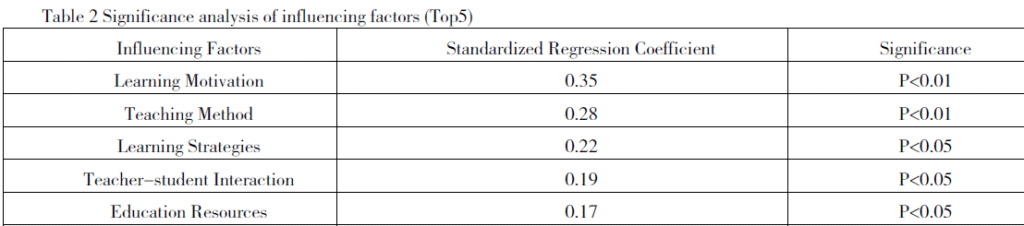
The effectiveness of college English learning is affected by many factors, including student factors (such as learning motivation, learning strategies, etc.), teaching factors (such as teaching methods,teacher-student interaction, etc.), and environmental factors (such as learning atmosphere , learning facilities, etc.). Using big data analysis methods, explore the key factors that affect English learning effects and their mechanisms of action, and provide decision-making basis for optimizing teaching. Taking student factors as an example, structural equation models can be used to analyze the relationship between learning motivation, learning strategies and other factors and English learning effects, and determine the significance and weight of each influencing factor, thereby identifying the main “levers” that affect learning effects. For another example, by using association rules to mine the correlation patterns between teaching factors and learning effects, discover the correlation strength between different teaching strategy combinations (such as flipped classroom + group cooperative learning) and learning effects, and find the best combination of teaching strategies.
2 Empirical research on innovation in college English teaching
2.1 Research design and methods
This study adopts the experimental research method, takes the college English course of a certain university as the research object, and randomly selects two teaching classes as the experimental group and the control group. The experimental group adopted an innovative teaching model based on artificial intelligence and mobile Internet, while the control group adopted a traditional teaching model. Before and after the experiment, English proficiency tests and questionnaire surveys were conducted on the two groups of students to collect students’ learning effect data and feedback. At the same time, through teacher interviews, classroom observations, etc., we can understand the implementation process and effects of innovative teaching models. SPSS software was used to conduct statistical analysis on the collected data to test the effectiveness of the innovative teaching model. The measurement tools used in the study include English proficiency test questions, learning experience scale, learning investment scale, etc. to ensure the reliability and validity of the research.
2.2 Analysis of experimental effects of intelligent learning system
Intelligent learning systems are an important starting point for innovation in college English teaching. This study takes the application of an English intelligent learning platform in a university as an example to examine its impact on students’ English learning. Students in the experimental group used an intelligent learning platform to study English for one semester. The platform provided personalized learning resource push, adaptive learning paths, intelligent learning tasks and timely feedback based on students’ academic data; students in the control group used traditional English learning style. By comparing the English scores and learning experiences of the two groups of students, it was found that the experimental group’s students’ listening, speaking, reading, writing, and translation abilities had significantly improved, and their learning interest and independent learning ability had also been enhanced. In addition, based on the analysis of learning process data, it was found that indicators such as the duration of use of the intelligent learning system and the degree of completion of learning tasks are positively correlated with students’ English learning effects.

Note: * means p<0.05, ** means p<0.01
2.3 Examination of the application effectiveness of blended teaching
This study examines the effectiveness of blended teaching in college English courses in a certain university. Before class, teachers release preview tasks on the online platform, and students watch micro videos and complete online exercises independently; during class, teachers focus on key contents, organize group discussions, scenario simulations and other interactive activities, and use the teaching platform to implement brainstorming and online tests. etc.; after class, students complete personalized consolidation exercises through the platform, and teachers answer questions and expand online. The study uses questionnaire surveys, performance analysis and other methods to evaluate the effectiveness of blended teaching. The results show that 89% of students believe that blended teaching can promote English learning, 93% of students like classroom interaction, and 85% of students believe that online learning resources are helpful for independent learning. Compared with traditional teaching, after adopting blended teaching, students’ final English scores increased by an average of 7.5 points.

Conclusion:
The results of this study emphasize that adopting innovative technologies and data-driven methods is crucial for improving college English teaching. By making use of big data analysis and intelligent learning systems, teachers can design personalized learning plans, recommend appropriate teaching resources, and effectively boost students’ engagement and learning outcomes. As the digital environment keeps evolving, educators need to continuously adapt and innovate, so as to build a dynamic and flexible learning environment that promotes students’ English language acquisition.
References:
【1】Hui ,Guan ,Wenping , et al.A Study on Digital Literacy of College English Teachers in Digital Age[J].Internatio
nal Journal of Mathematics and Systems Science,2024,7(2):
【2】Aiqing G ,Qin W .Application of Digital Network Teaching Platform in the Ideological Education of College English[J].International Journal of New Developments in Education,2024,6(1):
【 3 】 Guo Jianwei, Ji Guanping. Research on High-Quality Development Paths of Virtual Teaching and Research Rooms for “College English” Courses in the Context of Educational
Digitization [J]. Journal of Tonghua Normal University, 2024,
45(03):134-138.
【4】Zhang Jingyuan, Zhao Hongyan. Innovative Paths of College English Teaching under the Background of Digital Transformation [J]. Journal of Foreign Languages.,2024,(02):84-DOI:10.16263/j.cnki.23-1071/h.2024.02.012.
【5】Wan Jie. Research on Multimodal Teaching of College English in the Era of Artificial Intelligence [J]. Overseas English.,2024,(04):141-143.
【6】Martynov ,G. V,Oganov,et al.Digital educational technologies in teaching students at Gubkin University (Russian)[J].Oil Industry Journal,2020,2020(3):9-13.
【7】Margaryan D T ,Kalugina V L .Digital Transformation of English Language Teaching (ELT) at a Technical University: BMSTU Case Study[J].ITM Web of Conferences,2020,3501009 -.Fund Project:This paper was part of the project of Research on Classroom Management and Interaction Strategies in College Foreign Language Teaching Based on Generative Artificial Intelligence supported by 2024 Higher Education Research Project of Hubei Association of Higher Education (Grant No. 2024XD118).
